This month, the "Web Analytics in Québec city", or "WAQ" for short, join again with Yulbiz-Québec, organized by my friend and web analytics entrepreneur Stéphane Guérin.
Who: bloggers, entrepreneurs, strategists, designers, web analysts, VC, geeks :)
When: Wednesday, November 21th, around 7:00pm
Where: Taverne Urbaine chez Mo, 810 boul. Charest Est, Québec
Come join us for a chat, a drink and some tapas!
You might want to let me know or RSVP on the Yulbiz-Québec Facebook group if you come.
Friday, November 16, 2007
WASP 0.29: a week later
It's been a week since the release of WASP 0.29 and being in the field of web analytics, I couldn't resists reporting on some insight I got.
Numbers, numbers, numbers
I'm receiving great feedback about WASP. People like the new status bar indicator and I received a couple of requests to for additional products to detect, or small glitches here and there on specific sites (usually sites that have weird implementations!).
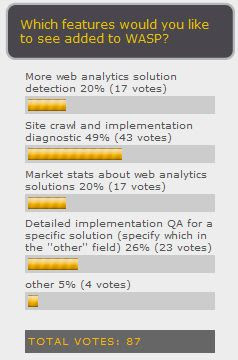 Which brings the next question, below "Which features would you like to see added to WASP?".
But this inevitably brings another question...
 So far, I have spent dozens of hours (I stopped counting!) working on WASP. Creating WASP is a great experience in itself and it's rewarding to see the interest picking up. Honestly, it's also bringing a fair amount of "attention" which translates in other opportunities. Being perceived as a thought leader, innovator and helping out the community is great, but in and by itself, WASP needs to bring some tangible outcomes.
It's interesting to see that most respondents to my little survey say a "donation model" appears to be, in their view, the most appropriate one. The WASP user interface clearly shows a "Make a Donation" button and the website as a clear call to action to make donations. Here's the results:
Numbers, numbers, numbers
- Number of downloads of WASP in a week: 4,500
- Total number of downloads since first launch: 24,000
- Number of sites visited by WASP users in a week: 4,300
- Number of pages analyzed by WASP in a week: 63,900
- Current number of products detected by WASP: 55
I'm receiving great feedback about WASP. People like the new status bar indicator and I received a couple of requests to for additional products to detect, or small glitches here and there on specific sites (usually sites that have weird implementations!).
What you want to see in WASP?
Let me share my dilemna regarding an advanced version of WASP: aim for the mass or aim for the bucks?- Creating "WASP Google Analytics Edition" would probably be very popular, but SiteScan exists, is free, and is doing a good job. Furthermore, from a purely commercial perspective, why would people pay for a QA tool while Google Analytics is free?
- Creating "WASP Omniture Edition" would probably be much more interesting, especially with the type of clients Omniture has and the recent industry shakeup.
Which brings the next question, below "Which features would you like to see added to WASP?".But this inevitably brings another question...
Which model would fit?
So far, I have spent dozens of hours (I stopped counting!) working on WASP. Creating WASP is a great experience in itself and it's rewarding to see the interest picking up. Honestly, it's also bringing a fair amount of "attention" which translates in other opportunities. Being perceived as a thought leader, innovator and helping out the community is great, but in and by itself, WASP needs to bring some tangible outcomes.It's interesting to see that most respondents to my little survey say a "donation model" appears to be, in their view, the most appropriate one. The WASP user interface clearly shows a "Make a Donation" button and the website as a clear call to action to make donations. Here's the results:
Since the first launch of WASP, there has been 2 donations, for a whopping total amount of 30$!Am I complaining? No! I just thought I would share this info and seek your input. Please fill out the poll. Please send in your comments and if you are inclined to do so, let me know, honestly, how much would you pay to make sure your site is correctly tagged? (or email me privately)
Thursday, November 15, 2007
Webcom-Montreal: optimization through web analytics
Yesterday, I had the pleasure to be on a panel at Webcom-Montreal with my friends Jacques Warren and Simon Rivard to talk about using web analytics for site optimization. Here's some highlights from this presentation.
What is web analytics?
Jacques suggested a definition, here's mine, which is slightly modified from the one proposed by Avinash Kaushik:"Web Analytics is the analysis of qualitative and quantitative data from your website, the competition and business systems to drive a continual improvement of the online experience that your customers, and potential customers have, which translates into desired business outcomes (online and offline)".I'm adding "business sytems" as an important source of information used for analysis.
Why use web analytics?
We were unanimous on that one! Through the use of web analytics, we aim to answer three simple questions. You might change the way those questions are formulated, but it's essentially:- Who is coming to the site?
- Why are they coming? What's their goal?
- Were they successful in accomplishing their goal?
What skills are required to do web analytics?
I proposed three key elements to be successful in web analytics:- Business acumen: knowledge of the specific business area, the global strategy, and how this strategy is facilitated by the Internet. Understand the goals and the processes related to ebusiness and "speak the language of business".
- Technology savvy: general web and internet concepts and best practices (and sometimes deep understanding!). The architecture and how the site is constructed, structured and applications are conceived.
- Analytical mind: ability to analyze data of various nature. Correlate it to business objectives and provide recommendations. Communicate efficiently to all stakeholders.
How can we improve a site?
Once we have a better insight on the three essential questions, we can seek to improve the site. Simon suggested the following areas of improvement:- Spotting technical problems such as bugs, broken links or server errors
- Understanding the level of interest (engagement) of visitors (where they come from, what's their interest, what they are doing on the site, etc.)
- Better qualifying target audiences (especially in the context of marketing activities)
- Improving usability and communication efficiency
- Improving business processes
What bounce rate or conversion ratios are ideals for...
We knew someone would ask! Simon joked: 0% bounce, 100% conversion!- For eCommerce, some studies mention conversion from visit to purchase of 4% as being a good objective, 8% is exceptional.
- But each business strategy being different, and each expression of that strategy on the web being specific, bounce rates, ratios and conversion rates should never (well, maybe not never, but very rarely!) be compared from one company to the other.
Where can I find more info about web analytics?
You are here! It's already a good start :)- Locally: "[WAM] Web Analytics Montreal" and "[WAQ] Web Analytics Quebec" are two monthly events happening in... Montreal and Quebec city were a bunch of people in the field get together for a drink, network, exchange and hear about the latest industry news. Look at blog.immeria.net/search/label/Event for the latest web analytics events (local and abroad) or subscribe to immeria's blog feed to stay aware of local events in Quebec. If you are on Facebook, you can join the group "Web Analytics Quebec".
- Association: The Web Analytics Association foster the interest of the web analytics industry and offers content, events, networking, webcasts, etc.
- Education: The University of British Columbia offers the Award of Achievement in Web Analytics. I will be tutoring the Introduction to Web Analytics course in January, and Web Analytics for Site Optimization later on.
- Conference: eMetrics Marketing Optimization Summit is THE conference on web analytics. The next one is coming in Toronto in early April. I'm on the advisory board for that conference.
- Blog: The blog of Avinash Kaushik is renowned to be the best one on the topic of web analytics.
- Discussion group: The Web Analytics Yahoo! Group is also a great place to learn. But please, before asking a question, look for older posts, there's a big chance someone already asked a similar question!
Subscribe to:
Posts
(
Atom
)